Personalization depends on the context a system can use. A name in a template offers little context. A free-form prompt offers little structure. maxclicks connects the business records, the decision about who should hear from you, and the parts of a message that can be written for each person.
A model of your business.
Schemas describe contacts, objects and events with typed attributes. A person can belong to an account; an order can refer to a customer; a project can have a creator. Keeping these records and relationships explicit gives the system a basis for querying and expanding the right context.
Stored attributes carry values you supply. Imports, integrations and APIs bring those values into the workspace. Schema validation gives that input a defined shape before a message or workflow relies on it.
Context beyond stored fields.
Many useful questions are not columns in a source database. How many projects did this person create? How long has it been since their latest order? An evaluated attribute turns a described question into a reusable field, computed on demand from the relevant records.
Attribute expansion supplies related records rather than just a scalar answer. An audience can use a purchase count to select a customer, while the email uses the expanded purchases to understand that person’s actual history. Those are different jobs built on the same model.
Intent becomes a definition you can review.
maxinja prepares logic from plain-language requirements for evaluated fields, segments and workflow conditions. The generated expression runs on the server. The product presents the requirements and a readable description so the operator can check that the definition expresses the intended business rule.
Correct relationships matter. In the Loopwell demo, Maya and Daniel belong to the same account. Daniel’s project does not count as Maya’s project. An activation audience has to preserve that distinction before any personal email is written.
A boundary around generated writing.
Adaptyle lets the author decide which parts of an email can change. The fixed offer, layout and links can remain authored content, while a designated paragraph or subject uses recipient-specific instructions. Liquid references connect the template to its expected data.
Brand-kit content, colors, styles and voice provide the brand context. Sample previews make the result inspectable for actual recipients. Base and personalized views let the author compare the approved structure with the generated writing.
Data grounding does not make AI infallible. Reviewing the definition, input records and rendered email remains part of the work. A successful preview is evidence about that sample; it is not a claim that every recipient has been checked or that a campaign has been delivered.
Agents work across the preparation.
Writing a paragraph is only one part of customer engagement. maxinja can help prepare the schemas, audience, brand kit and campaign around it. The operator can inspect the resulting artifact in the same workspace and continue from the actual product controls.
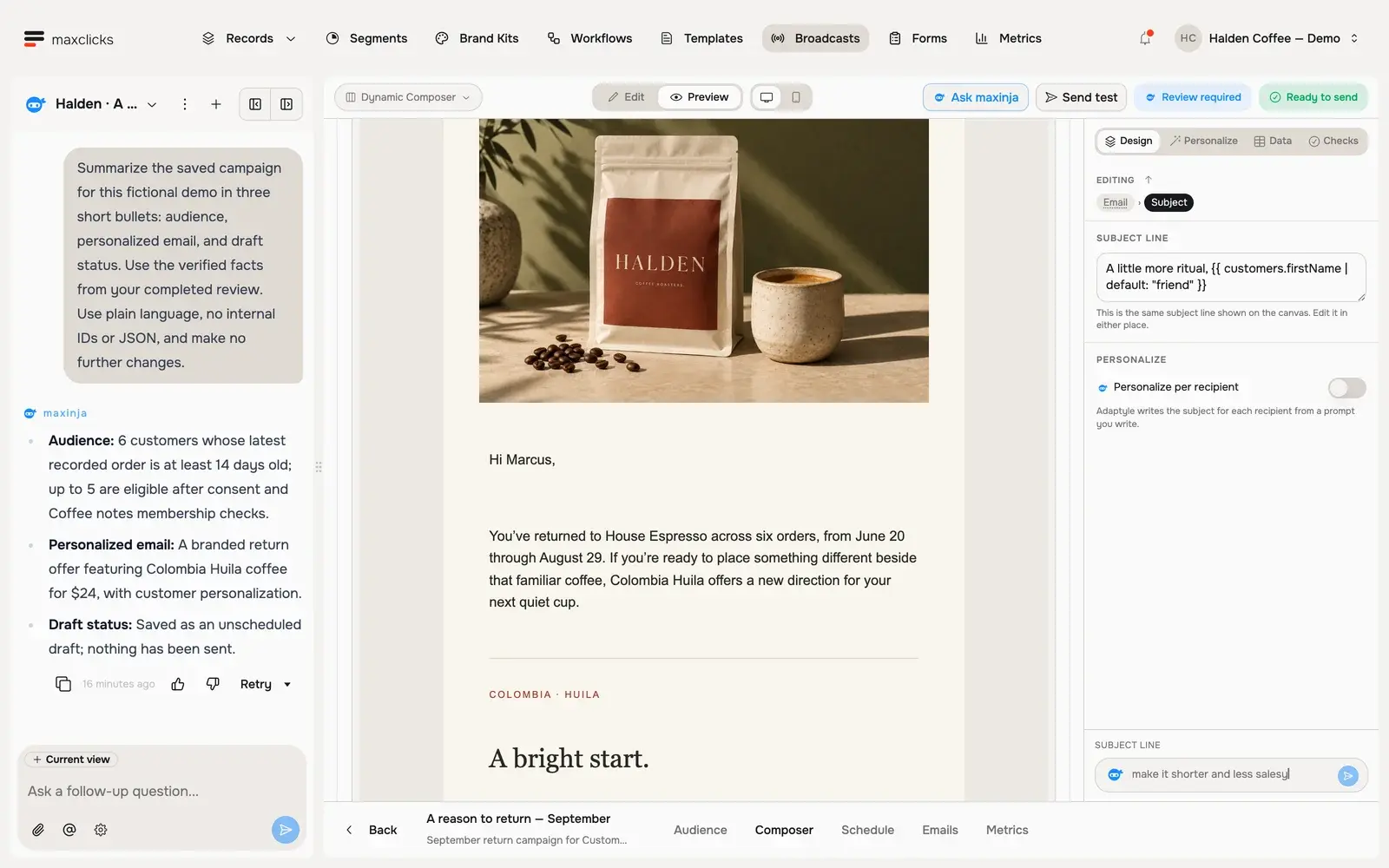
Our Halden example illustrates that boundary. A completed agent review repaired the audience definition, selected the existing sender and preserved the personal email. The result remained an unscheduled draft. The product showed the audience count and the review still required before sending.
A journey checks what changed.
Workflows connect an event to recipient selection, waits, current-record lookups, conditions and later actions. A follow-up can check for a newer purchase or a first project before taking the email branch. The message should follow the current state of the journey.
Broadcasts organize an audience around a campaign. Reusable templates can also be called from an application through REST or SMTP. Email is the sending channel available today. Sending domains, sender profiles, topics, consent and eligibility are part of the delivery configuration.
The design principles.
- Ground the writing in records. Give the message the specific context needed for its task.
- Compute reusable answers. Define a value once and evaluate it where it is used.
- Keep the decision inspectable. Show the requirements, matching records and the next workflow step.
- Make generation selective. Decide which passages may change and keep the approved constraints explicit.
- Distinguish preparation from delivery. A saved draft, a preview, a completed workflow run and a sent email are different kinds of evidence.